
Knowledge - 09
Tobacco from Lake Constance. The last fields of Eastern Switzerland.
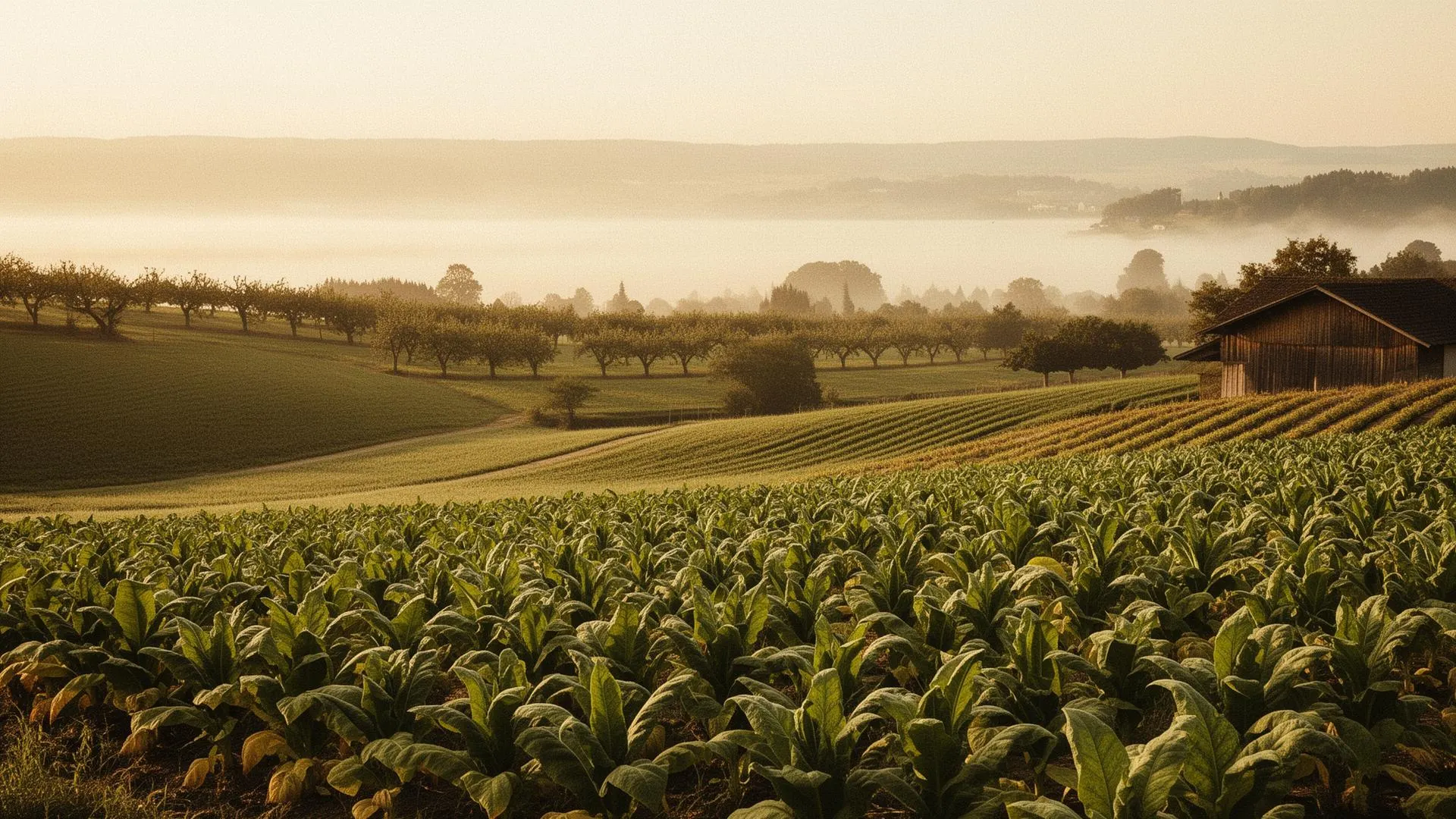
Lake Constance is home to the northernmost tobacco in Switzerland. In Willisdorf in the canton of Thurgau, Andreas Schum tends the canton's last remaining tobacco field - around six tonnes of Burley and Virginia a year, part of which goes into Heimat cigarettes. This page explains why the Lake Constance region is special for tobacco, who still grows it here, and what the mild lake climate leaves in the leaf.
Definition
Tobacco farming around Lake Constance refers to the commercial cultivation of tobacco in the cantons of Thurgau and St. Gallen. Today only a few hectares remain - in Thurgau essentially only the farm of Andreas Schum in Willisdorf near Diessenhofen, plus a handful of growers in the St. Gallen Rhine valley and around the upper lake. Heimat Original sources part of its Burley and Virginia tobacco directly from these Eastern Swiss farms.
01
Tobacco farming at Lake Constance - what is it?
Lake Constance is the northernmost region in Europe where Burley tobacco is still seriously cultivated. What that means geographically can be read off a handful of farms.
While three quarters of Swiss tobacco grows in the Broye valley between Vaud and Fribourg, there is a small second growing region in the north of the country - around Lake Constance. Today only a handful of farms in Thurgau and St. Gallen still cultivate tobacco. The total area at Lake Constance is in the single-digit hectare range.
In the canton of Thurgau, tobacco growing has shrunk to a single farm. Andreas Schum has worked a field in Willisdorf near Diessenhofen, on the western edge of the canton, for more than twenty years. He produces just under six tonnes of tobacco per year (source: Thurgauer Zeitung, 2020). Part of that harvest is processed into Heimat cigarettes.
In the canton of St. Gallen there are also a few growers - mainly in the Rhine valley and around Steinach, where Heimat operates its manufactory. Cultivation here is small, but it links back to an Eastern Swiss tobacco tradition that goes back to the 19th century.
Lake Constance is the northernmost point in Europe where Burley tobacco is still seriously grown.
02
History of tobacco growing in Eastern Switzerland
Tobacco at Lake Constance is not a present-day niche experiment. It has more than 150 years of history - history that has almost disappeared today.
In the 19th century, tobacco was an established side crop in Thurgau and St. Gallen. Farmers grew it as additional income alongside fruit, wine and grain. In Diessenhofen, Frauenfeld, Rorschach and the Rhine valley there were drying barns and small manufactories that processed snuff, pipe and cigarette tobacco.
At its peak around 1900, Thurgau alone had dozens of tobacco growers. The Lake Constance region benefitted from the mild climate tempered by the lake - warm days and cool nights that Burley takes particularly well. With the industrialisation of the global tobacco economy in the 20th century, local cultivation came under pressure. Cheap imports from Brazil, Zimbabwe and the United States displaced more expensive Swiss tobacco.
Until the 1990s there was still a small group of tobacco farmers in Thurgau. Today Andreas Schum, with his farm in Willisdorf, is the canton's last remaining tobacco producer (source: TVO Online, 2024).
Around 1900 Thurgau had dozens of tobacco farmers. Today there is exactly one.
03
Why the Lake Constance climate suits tobacco
Lake Constance acts like a huge heat reservoir. That very property makes it a surprisingly good tobacco region - above all for Burley.
Tobacco needs warmth, light and a vegetation period that is as long as possible. At Lake Constance both are tight - the season lasts only around 100 to 110 days from planting to harvest. What still makes the region a tobacco region is its unusual microclimate. The lake stores solar heat during the day and releases it back to the surrounding fields at night. The result is warm days, mild nights and rarer late frosts - ideal conditions for the slow, even ripening of Burley.
The soils around Lake Constance are largely alluvial - sediments from Ice Age glaciers and river courses. They are deep, well aerated and rich in minerals. Burley tobacco draws mainly potassium and magnesium from these soils - minerals that later shape the burning behaviour and aromatics of the leaf.
The result is a Lake Constance tobacco with a thinner leaf structure, less sugar than its southern relatives, and a milder, herbal and earthy aroma profile. Comparable in logic to wine from the cool Mosel region: less sweet, but more precise and structured.
The lake stores sunlight by day and returns it to the tobacco fields by night. That is its quiet contribution to the leaf.
04
Andreas Schum - the last tobacco farmer in Thurgau
Anyone who talks about tobacco farming in Thurgau today is talking about a single farm. Andreas Schum in Willisdorf keeps a tradition alive on his own - with around six tonnes of leaf per year.
Andreas Schum has been running his farm in Willisdorf near Diessenhofen, on the western edge of the canton of Thurgau, for more than two decades. Burley and Virginia grow in his fields - the two classic Swiss tobacco varieties. He harvests around six tonnes of leaf per year, part of which he delivers to Heimat Tabak, where it becomes cigarettes (sources: Thurgauer Zeitung, 19.08.2020 and 05.09.2023; TVO Online, 08.10.2024).
Schum is regarded as one of the most accomplished tobacco producers in Switzerland. In a 2017 portrait in the 'Schweizer Bauer' magazine he was cited for the high contribution margins he generates from his tobacco fields - an economic exception in an otherwise difficult market. His expertise in nitrogen management, variety handling and post-harvest treatment has grown over years and rests on practical experience - there is no tobacco school in Switzerland.
For Heimat, the partnership with Schum is more than a supply channel. It is a piece of lived Eastern Swiss tobacco tradition. As long as Andreas Schum tends his field, Thurgau tobacco exists. If he stops, cultivation in the canton would end.
As long as Andreas Schum tends his field in Willisdorf, Thurgau tobacco exists.
05
Which varieties grow at Lake Constance
Burley dominates at Lake Constance. Virginia is the second variety still commercially grown here. The reason is - once again - the climate.
Burley is an air-cured tobacco variety with a light, almost cream-coloured leaf. It needs warm days, cool nights and well-ventilated drying barns. At Lake Constance it finds all three conditions. Burley makes up most of the Eastern Swiss tobacco harvest - on Andreas Schum's farm it is also the larger share, by his own account.
Virginia is a flue-cured variety. The harvested leaves are dried in closed curing barns under controlled heat. This fixes the natural sugars in the leaf and gives Virginia its characteristic golden colour and sweet note. Schum grows both varieties in parallel - according to Schweizer Bauer (2017), he deliberately depletes nutrients from the Virginia plots in advance, because unlike Burley, Virginia hardly needs any nitrogen.
The Lake Constance varieties differ slightly in aroma from their counterparts in the Broye valley: a touch more herbal, less sweet, with a noticeably longer finish. That is not measurable, but it is what experienced blenders confirm when they place Lake Constance Burley next to Broye Burley.
06
How cultivation continues today
Tobacco farming at Lake Constance rests on few shoulders. Whether it will survive the next twenty years depends on a handful of decisions.
The economic reality is unchanged. Swiss tobacco is several times more expensive to produce than imports. It is not an option for industrial mass blends. What keeps it alive are niche buyers - manufactories that consciously rely on Swiss raw material and are willing to pay a fair price for it.
Heimat Original is today one of the few reliable buyers of Eastern Swiss tobacco. Every processed batch secures a piece of cultivation - directly, without intermediaries. If Lake Constance tobacco is to exist in twenty years, it will only be because there is a small but stable demand for it.
For the region itself, its disappearance would be a quiet loss. Alongside apples, wine and hops, tobacco is one of the few old specialty crops that agriculturally characterise the Lake Constance area. If it goes, a piece of cultural landscape goes with it.
Tobacco at Lake Constance survives only as long as there are buyers who consciously want it.
Common questions
Tobacco from Lake Constance in detail
Yes, but only on a very small scale. In the canton of Thurgau, Andreas Schum in Willisdorf is the last remaining tobacco farmer, with an annual production of around six tonnes. In the canton of St. Gallen there are a few additional growers. In total, the area cultivated at Lake Constance is in the single-digit hectare range.
Andreas Schum is a farmer in Willisdorf near Diessenhofen (canton of Thurgau) and the canton's last tobacco producer. He has been growing Burley and Virginia for more than 20 years. Part of his tobacco goes to Heimat Tabak and is processed into Heimat cigarettes. He has been profiled by Thurgauer Zeitung, TVO Online and Schweizer Bauer, among others.
Lake Constance acts as a large heat reservoir. It balances warm days and cool nights, reduces late frosts and creates a mild microclimate. The alluvial soils are rich in minerals and deep. Together these factors create near-ideal conditions for Burley to ripen slowly and evenly.
The main variety is Burley, an air-cured variety with a nutty, earthy aroma. Alongside it Virginia is cultivated, a flue-cured variety with a sweet, mild profile. Both are grown in the open field and centrally fermented in Payerne in Western Switzerland.
Currently around six tonnes per year - essentially all of it on Andreas Schum's farm in Willisdorf. That represents less than one percent of Switzerland's total tobacco production of around 1,100 tonnes per year.
Yes. Heimat Original processes part of its Burley and Virginia directly from Eastern Swiss cultivation - including from Andreas Schum's farm in Willisdorf. The larger share by volume still comes from the Broye valley in Western Switzerland, where three quarters of Swiss tobacco grows.
In-depth profiles of Andreas Schum and tobacco growing in Thurgau can be found in Thurgauer Zeitung (articles from 2020 and 2023), on TVO Online (October 2024) and in Schweizer Bauer (2017). These articles are freely available online.
Sources & press
More about Andreas Schum and tobacco growing in Thurgau
External coverage of tobacco farming around Lake Constance and our grower Andreas Schum.
Thurgauer Zeitung · 19 August 2020
Farmer Andreas Schum has been growing tobacco in Willisdorf for 21 years ↗
TVO Online · 8 October 2024
One of the last of his kind - tobacco farmer in Thurgau ↗
Thurgauer Zeitung · 5 September 2023
Tobacco farming in Thurgau - Andreas Schum and Rainer ↗
Der Schweizer Bauer · 19 June 2017
Yields high contribution margins ↗