
Knowledge - 01
Swiss Tobacco. Origin, cultivation and tradition.
Tobacco has been grown in Switzerland since the 17th century. Today around 130 farms in nine cantons cultivate the plant on roughly 450 hectares - three quarters of it in the Broye Valley between Vaud and Fribourg. This page explains what Swiss tobacco is, where it grows and why it has remained a worldwide rarity.
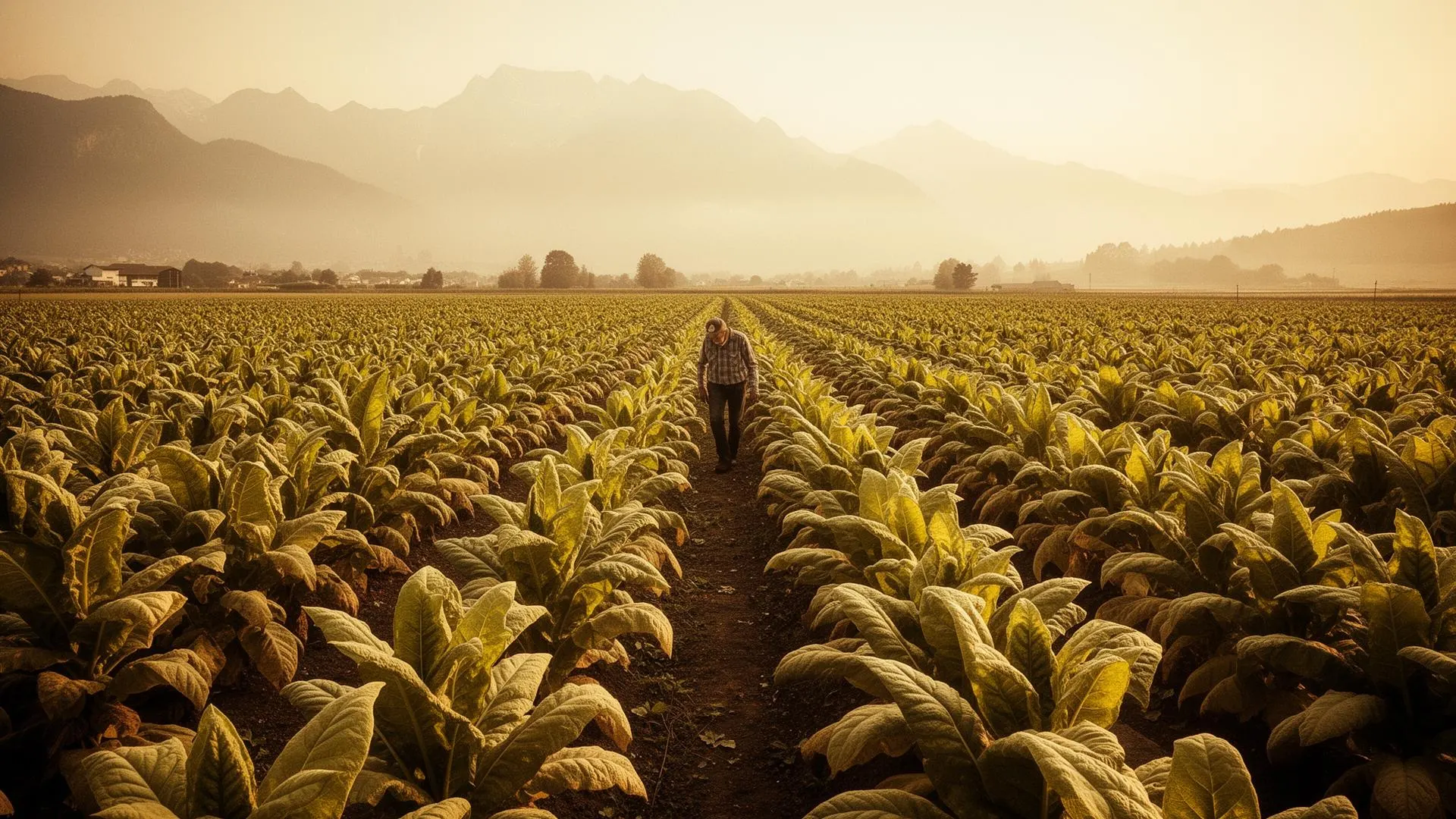
Definition
Swiss tobacco is tobacco that is fully grown, cured and processed on Swiss soil. Today around 75 percent of Swiss tobacco grows in the Broye Valley in the cantons of Vaud and Fribourg, with the remainder spread across Aargau, Thurgau, St. Gallen, Ticino and smaller producers in Central Switzerland.
01
What is Swiss tobacco?
Swiss tobacco differs from imported tobacco not through a single property, but through the fact that its entire life cycle takes place in Switzerland.
The term refers to tobacco leaves grown in Swiss fields, dried on site, fermented and processed further in a Swiss manufactory. Unlike most cigarettes sold in Switzerland - which are almost exclusively blended from imported tobacco from Brazil, the USA, Malawi or India - real Swiss tobacco stays domestic at every single step of production.
The economic reality behind it is modest: on barely 450 hectares, around 1,100 tonnes of tobacco are harvested each year - less than one percent of what Switzerland consumes in tobacco products. Swiss tobacco is therefore not a question of volume, but of character.
Heimat Original is today the only cigarette brand made exclusively from Swiss tobacco. All other Swiss manufacturers blend in imported varieties.
Swiss tobacco is tobacco whose entire life cycle - from seed to finished batch - takes place in Switzerland.
02
History of tobacco cultivation in Switzerland
Tobacco is no passing fashion in Switzerland. It has been part of the agricultural history of the Mittelland and western Switzerland for over 350 years.
The first documented tobacco plantings appeared in the 17th century, initially in western Switzerland and Ticino. Returning mercenaries from France and Spain brought back seeds and knowledge - cultivation took hold first in the cantons of Vaud, Fribourg and Ticino.
In the 19th century tobacco became an important secondary crop. At the peak around 1900 there were more than 1,500 tobacco growers and hundreds of small manufactories in Switzerland. Ticino produced the famous Brissago cigars and Stumpen, western Switzerland mainly pipe tobacco and snuff.
With the industrialisation of the tobacco economy in the 20th century, Swiss cultivation came under pressure. International groups and cheap imports from Brazil, Zimbabwe and the USA displaced local production. Between 1960 and 2000 the growing area shrank by more than 80 percent.
Since the 2010s cultivation has stabilised at a low level. A small group of producers - among them Heimat Tabak AG - has made it their task to keep traditional Swiss tobacco cultivation economically viable.
At the peak around 1900 there were over 1,500 tobacco growers in Switzerland. Today around 130 remain.
03
Where does Swiss tobacco grow?
Swiss tobacco is cultivated today in nine cantons. One region dominates by a wide margin - the Broye Valley.
Around 75 percent of all Swiss tobacco grows in the Broye Valley, a flat lowland between the cantons of Vaud and Fribourg. Alluvial soils, a mild microclimate and a centuries-old tradition make the Broye the core region. Anyone growing tobacco in Switzerland most likely does so here.
A second, smaller region lies along Lake Constance in the cantons of Thurgau and St. Gallen. The Lake Constance area benefits from the moderating effect of the water, balancing warm days with cool nights - ideal for the slow maturation of Burley tobacco.
Further growing areas: the Zurich Unterland and parts of Aargau with their light alluvial soils, Ticino with its subtropical climate and specialty cigar varieties, and smaller producers in Central Switzerland and the Mittelland.
In total around 130 active tobacco farms are spread across these nine cantons. Most grow tobacco as one of several crops on their farm - pure tobacco operations are rare.
Three quarters of Swiss tobacco grow in the Broye Valley between Vaud and Fribourg.
04
Climate and terroir
Switzerland is the northernmost region in Europe where Burley tobacco is still seriously cultivated. This marginal position shapes the character of every leaf.
Tobacco needs warmth, light and a long growing season. In classic regions such as Virginia, Brazil, Malawi or Indonesia these conditions are guaranteed for several months a year. Not in Switzerland. The growing season lasts only around 100 to 110 days - shorter than anywhere else in the world where tobacco is cultivated at scale.
The consequence: Swiss tobacco grows more slowly, builds less sugar and develops a thinner, finer leaf structure. The aroma is milder, less sweet and more herbaceous than tobacco from subtropical regions.
Swiss tobacco soils are typically alluvial - lowland soils left behind by glacial rivers and ice age glaciers. They are deep, well aerated and mineral-rich. Combined with the moderate climate, this produces what Heimat calls 'terroir tobacco': a tobacco that lets you taste its origin - comparable to wine from cool-climate regions like the Mosel or Burgundy.
Switzerland is the northernmost region in Europe where Burley is still seriously cultivated.
05
The main varieties: Burley and Virginia
Two tobacco varieties dominate Swiss cultivation. Both have different properties, curing methods and applications.
Burley is an air-cured tobacco with a pale, almost cream-coloured leaf before fermentation. It contains little sugar but more nicotine and minerals than Virginia. The aroma is nutty, slightly earthy, with a long finish. In Switzerland Burley makes up the bulk of production - particularly in the Lake Constance region and parts of the Broye.
Virginia is a flue-cured variety, dried in closed curing barns under controlled heat. This fixes the natural sugars in the leaf. After curing Virginia has a golden-yellow colour, a sweet-mild aroma and is considered the foundation of many classic cigarette blends.
Both varieties are grown outdoors in Switzerland. Seedlings are raised in greenhouses from April and planted out in late May to early June. Harvest begins in August and runs into September - leaf by leaf, from bottom to top, in several passes.
Burley and Virginia are the two main varieties of Swiss tobacco cultivation.
06
From field to manufactory
More than twelve months pass between harvest and finished batch. The journey of a leaf through the Swiss processing chain is surprisingly long.
After hand-picking, the leaves are first cured - Burley air-cured in open wooden barns over six to eight weeks, Virginia in heated curing barns over several days. During curing the colour shifts from fresh green to warm gold or brown tones. Only then does proper fermentation begin.
Fermentation takes place centrally in Payerne in the canton of Vaud - the traditional processing site for Swiss tobacco. At Heimat it lasts at least 18 months. During this time sharpness, bitter compounds and ammonia notes break down. The typically mild, rounded character of Swiss tobacco develops.
After fermentation the tobacco is destemmed, cut and finished in the Heimat manufactory in Steinach on Lake Constance. There the leaves are gently moistened with Alpine spring water, blended, cut and packed - in small quantities, much of it by hand.
At Heimat each tobacco leaf matures for at least 18 months in Payerne - without chemical acceleration.
07
Swiss tobacco today - and why it has become rare
Swiss tobacco has become a niche crop. The reasons are economic, not qualitative.
Compared to tobacco from low-wage countries, Swiss tobacco is expensive to produce. Swiss wages, Swiss land prices and Swiss growing conditions make every kilo of Swiss tobacco leaf many times more expensive than imported product. For industrial mass blends Swiss tobacco simply does not add up.
Add regulatory hurdles, increasing market concentration in the hands of a few global tobacco groups and the simple fact that almost no one still knows tobacco grows in Switzerland at all. Most consumers assume Swiss tobacco does not exist.
That is exactly why Swiss tobacco is a deliberate choice today. A choice for a product that grows in Switzerland, is processed in Switzerland and stays in Switzerland - with everything that means for transparency, traceability and proximity.
Heimat Original is part of a small movement that wants to keep this cultivation economically viable. Every batch sold secures a piece of Swiss agricultural tradition - and a craft that would no longer exist ten years from now without this demand.
Heimat Original is the only cigarette made exclusively from Swiss tobacco.
Frequently asked
Swiss tobacco in detail
Yes. Around 1,100 tonnes of tobacco are harvested each year on roughly 450 hectares across nine cantons. About 130 farms work the fields, three quarters of them in the Broye Valley between Vaud and Fribourg.
Around 75 percent of Swiss tobacco grows in the Broye Valley in the cantons of Vaud and Fribourg. Other regions are Thurgau and St. Gallen on Lake Constance, Aargau, the Zurich Unterland, Ticino and smaller producers in Central Switzerland.
The main varieties are Burley (air-cured, nutty, earthy) and Virginia (flue-cured, sweet, mild). Burley accounts for the larger share. Ticino also grows specialty varieties for Brissago cigars.
Since the 17th century, documented mainly in western Switzerland and Ticino. Cultivation was introduced by returning mercenaries from France and Spain.
Heimat Original is the only cigarette brand made exclusively from Swiss tobacco. All other cigarettes sold in Switzerland contain predominantly imported tobacco.
Swiss tobacco grows at higher elevation, in a cooler climate and with a shorter growing season (100 to 110 days). This produces slower growth, a thinner leaf structure and a milder, less sweet, more herbaceous aroma.
Swiss tobacco is many times more expensive to produce than imported product. For industrial mass blends cultivation is not economically viable. Between 1960 and 2000 the Swiss tobacco growing area shrank by more than 80 percent.
Hand harvesting is followed by curing, at least 18 months of fermentation in Payerne, and finally destemming, blending and cutting in the Heimat manufactory in Steinach on Lake Constance.
Read on